 pinch.
Pinch Whitepaper
Version 1.0 · 5 November 2026 · Technical whitepaper
Abstract
Pinch is a proof-of-work blockchain whose native coin, PINCH, lets two strangers trade with collateral and leave each other a public, weighted rating, with no arbiter in between. It is an EVM-compatible network (chain ID 5261646) run on a modified core-geth node, mined with Ethash, launched on 2 November 2026 with no premine and no sale. The collateral and rating rules live in one ownerless smart contract that is part of the genesis block, so nobody can change, pause or upgrade them. Block rewards follow a fixed 210 million PINCH schedule, and from block 20,000 mining requires a minimum balance that starts at 2,500 PINCH and rises with supply to at most 25,000 PINCH, with rewards that grow with the miner's balance.
1. Motivation
Two parties who do not know each other usually need a middleman to trade: an escrow service, a marketplace or a court. Each middleman decides disputes by its own rules and can be wrong, slow, biased or unreachable. Pinch takes the opposite approach: no one decides disputes. Instead, the protocol makes cheating expensive and visible.
Three ideas carry the design:
- Collateral by default. The payer locks the payment for the payee before the goods or service are delivered, with a deadline. If nothing happens, the payee becomes entitled to payment, finalized by a claim transaction.
- A costly exit instead of a judge. The payer can stop the payment, but the money is then frozen for 180 days, and only the payee may rate the payer. Stopping is possible, never free.
- Reputation that is hard to fake. Every rating is public and weighted by the rater's own history of real, paid deals. A rating from an empty wallet counts for little.
The rules follow a simple principle: the person who controls the money carries the cost of misusing it, and everyone can see the record.
2. Network
Pinch is a standalone layer-1 chain secured by Ethash proof of work, compatible with the Ethereum Virtual Machine and standard Ethereum wallets.
| Parameter | Value |
|---|---|
| Name / symbol | Pinch / PINCH, 18 decimals |
| Chain ID / network ID | 5261646 |
| Consensus | Ethash proof of work, difficulty adjusted every block (target about 13 s per block) |
| Node software | core-geth 1.13.0 (commit 85093c85) with the PINCH-STAKE-1 patch, released as 1.13.0-pinch.3 |
| EVM rules | Ethereum Classic fork set active from block 0, including Shanghai (PUSH0) |
| Genesis | 2 November 2026, 19:42:45 UTC; hash 0xc8d0b22a…3e78c9a2; extra data "Pinch 2026-11-02 no premine" |
| Genesis allocation | Only the PinchDeals contract at 0x00000000000000000000000000000000000dea15, balance 0 |
| Premine / sale | None. Every PINCH in existence was mined. |
| Public RPC | https://pinch.network/rpc |
| Explorer | https://pinch.network/explorer |
| Website | https://www.pinch.network |
No premine. The genesis block assigns no balance to any address. The first coins were created by the first mined block, under the same rules that apply to every miner.
Verifiable software. Node binaries for macOS, Windows and Linux are built from core-geth 1.13.0 plus a published patch. The Pinch miner package checks each downloaded binary against a SHA-256 hash pinned in its source code before running it.
Peers. The network currently relies on two public, non-mining nodes as static peers. Miners connect to these and keep a full copy of the chain. Node discovery is off while the network is small, to keep it from mixing with other Ethash networks. These nodes are a bootstrap measure: they help peers find each other and serve public RPC, but they hold no special rights. As independent nodes appear, they will be added as peers and the founder's nodes retired.
3. Monetary policy
PINCH has a fixed issuance schedule of 210,000,000 coins: 50 PINCH per block, halving every 2,100,000 blocks, reaching zero at block 138,600,000 after 66 halvings. The schedule is written into the genesis configuration and can only be changed by a hard fork that every node operator would have to adopt.
| Era | Blocks | Scheduled reward per block |
|---|---|---|
| 1 | 1 - 2,099,999 | 50 PINCH |
| 2 | 2,100,000 - 4,199,999 | 25 PINCH |
| 3 | 4,200,000 - 6,299,999 | 12.5 PINCH |
| 4 | 6,300,000 - 8,399,999 | 6.25 PINCH |
| Following eras | Each next 2,100,000-block interval | Halved, rounded down to whole wei |
| Final zero-reward era | From block 138,600,000 | 0 PINCH |
Genesis block 0 creates no coins. This is the scheduled maximum reward; actual issuance after activation uses the eligible miner's tier.
At the target block time of about 13 seconds an era lasts roughly 11 months; the real length depends on the hashrate and difficulty.
Uncle rewards. Ethash pays extra rewards for "uncle" blocks (valid blocks that lost a race) on top of the block reward. Up to block 11,023 this added 20 uncles and 906.25 PINCH above the schedule. From block 20,000 uncle rewards are no longer paid, so after that point no block can mint more than its scheduled reward. Total supply is therefore bounded by 210,000,000 PINCH plus the uncle rewards minted before block 20,000, a figure fixed and published at activation.
Fees. EIP-1559 is not active on Pinch: there is no base fee and nothing is burned. Every transaction fee goes to the miner of the block. The block gas limit is 30,000,000.
4. Stake-gated mining (PINCH-STAKE-1)
From block 20,000, a block is valid only if the address that mined it holds at least the mining threshold T, and the reward grows with that balance. T equals 0.25% of the scheduled supply mined so far, capped at 25,000 PINCH, so it starts low while few coins exist and rises as supply grows. Proof of work still decides who finds a block; the balance decides whether the block counts and how much it pays.
| Block | Scheduled supply so far | Threshold T |
|---|---|---|
| 20,000 (activation) | 1,000,000 PINCH | 2,500 PINCH |
| 100,000 | 5,000,000 PINCH | 12,500 PINCH |
| 200,000 and later | 10,000,000+ PINCH | 25,000 PINCH (cap) |
| Miner's balance | Share of scheduled reward | Reward per block in era 1 |
|---|---|---|
| below T | — | block rejected |
| T or more | 50% | 25 PINCH |
| 4 × T or more | 60% | 30 PINCH |
| 8 × T or more | 75% | 37.5 PINCH |
| 20 × T or more | 100% | 50 PINCH |
How it is measured. T depends only on the block number, so every node computes the same value. The balance is read after the block's own transactions are applied and before any reward is credited. Rewards in later eras scale the same way (for example 12.5 PINCH at the lowest tier in era 2). The unpaid part of a reduced reward is never minted.
Enforcement. Every upgraded node rejects a block whose miner is below the threshold, and the mining software does not assemble such a block in the first place. The Pinch miner pauses mining automatically while its reward address is below the threshold and keeps the node in sync.
Why. The rule ties block production to holding PINCH, in addition to spending electricity. A miner with rented hashpower but no coins cannot produce valid blocks, which raises the cost of attacking a young network. It also rewards miners who keep a stake in the network rather than selling every coin they mine.
Trade-offs.
- A new miner must first hold the threshold amount, by receiving PINCH from an existing holder, before mining. The threshold is lowest in the early period and rises to 25,000 PINCH as supply grows.
- Larger holders earn more per block, which can concentrate supply over time.
- Several machines can mine to one address (pool style); the tier depends only on that address's balance.
- The rule changes consensus. Nodes that did not upgrade before block 20,000 follow a separate chain.
5. Collateral deals
A deal locks PINCH from a payer (A) for a payee (B) until A confirms, the deadline passes, both agree on a split, or A stops it at the cost of a 180-day freeze. The rules live in the PinchDeals contract at 0x00000000000000000000000000000000000dea15, placed in the genesis block. It has no owner, no admin key, no upgrade path and no pause switch.
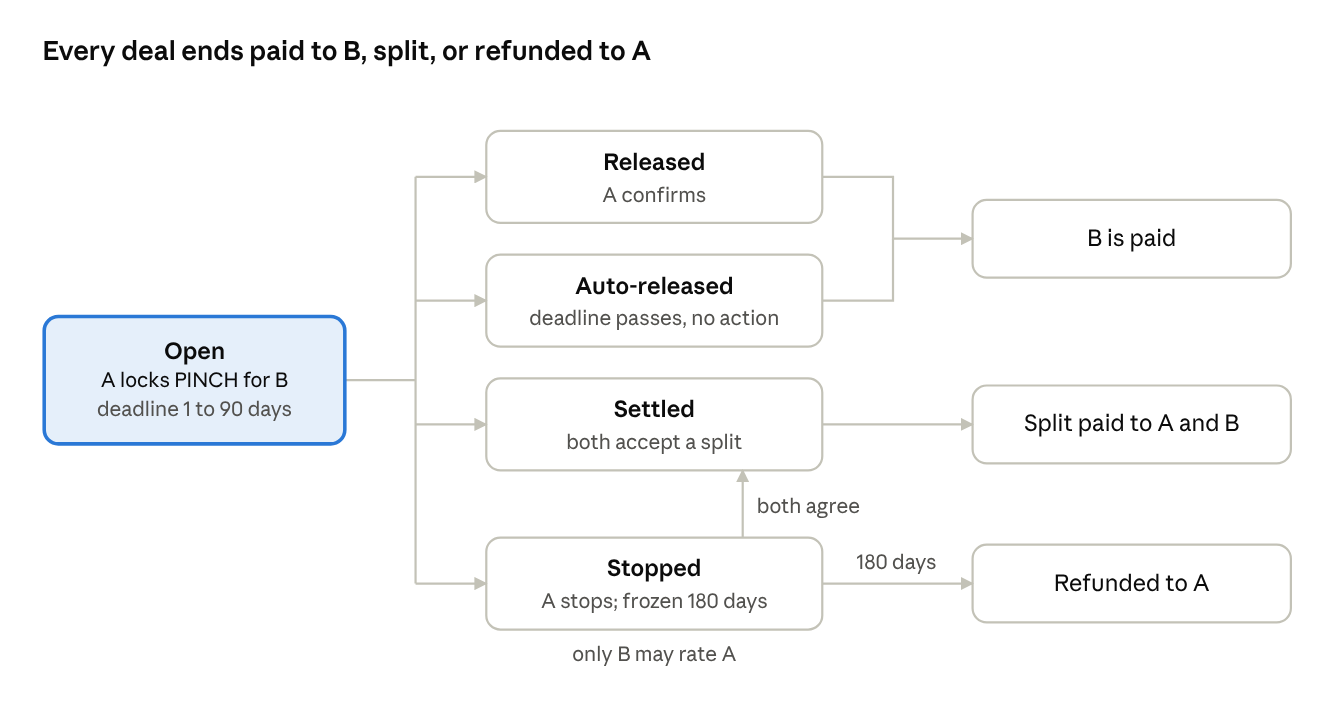
Only a stop by A delays the outcome, and even then the deal can still be settled by agreement.
- Open. A locks any amount of PINCH for B and sets a deadline of 1 to 90 days.
- Confirm. Before the deadline, A can release the payment; B receives it at once.
- Automatic confirmation. If A does nothing until the deadline, the deal counts as confirmed. Anyone can then trigger the transfer to B; the outcome no longer depends on A.
- Settle. At any point while the deal is open or stopped, one side proposes a split (amount to A, amount to B) and the other side accepts the same split. The funds are divided accordingly.
- Stop. Before the deadline, A can stop the deal. The funds are then frozen for 180 days and return to A afterwards, unless the two sides settle earlier. Only B may rate A on a stopped deal.
Payments. Payouts are sent directly. If the receiving address refuses the transfer, the amount is recorded for that address and can be withdrawn later, to the same or another address of the owner's choice. A deal can never be paid to anyone other than A or B.
What the contract does not do. It does not judge who is right, verify delivery, or know what was traded. The contract only enforces the money flow and records the outcome.
6. Public, weighted reputation
Every address has a public profile built from its deals, and each rating counts in proportion to the rater's own track record and the size of the deal. Ratings are scores from 1 to 5, one per party per deal, stored on chain and never editable.
| Deal outcome | A may rate B | B may rate A |
|---|---|---|
| Released by A | yes | yes |
| Automatically confirmed | yes | yes |
| Settled by agreement | yes | yes |
| Stopped by A (frozen or refunded) | no | yes |
The last row is the core deterrent: a payer who stops a deal cannot answer with a rating of their own, and the stop itself is counted publicly in their profile.
Rating weight. When a rating is given, its weight is fixed as:
w = (1 + min(P, 10)) × (1 + ⌊log2(1 + V / 1 PINCH)⌋)
P is the number of distinct partners, other than the rated address, with whom the rater completed a deal in which at least 1 PINCH was actually paid to the payee. V is the amount of the deal being rated. The weighted rating is the sum of weight × score divided by the sum of weights; the unweighted average is shown next to it.
What the profile shows. Deals as payer and as payee, completed deals, distinct partners, volume paid and received, deals stopped by the address, deals stopped against it, PINCH currently locked, and both rating averages.
Limits. Weighting makes fake ratings expensive: a fresh wallet rating itself through a puppet counts for little, and building weight requires real payments to many distinct partners. It does not prove identity, delivery or honesty, and a determined attacker with enough PINCH can still build weight. Profiles describe on-chain behaviour only.
7. Wallets and tools
Any standard EVM wallet works with Pinch once the network is added with chain ID 5261646; no custom wallet software is needed.
- Wallets. MetaMask, Trust Wallet and other EVM wallets can add Pinch as a custom network. Hardware wallets such as Ledger sign Pinch transactions through MetaMask with the Ethereum app; deal operations need the app's blind-signing setting. A listing in the public chain registry (ethereum-lists, used by Chainlist) has been submitted and is pending review.
- Deals app. A web app on the Pinch site connects to the user's wallet and covers every contract action: open, release, stop, claim, settle, rate and withdraw, plus public profiles. It only reads public chain data and asks the wallet to sign; it never sees keys.
- Explorer. A block explorer on the Pinch site shows blocks, transactions, addresses and deal profiles, read from the public node.
- Miner. A one-click package for macOS, Windows and Linux sets up a node, verifies the node binary, mines to an address chosen by the user, pauses on laptop battery and below the stake threshold, and can start at login. It asks only for a reward address, never for a private key or recovery phrase.
- Wrapped PINCH on Base. The deployed bridge locks native PINCH in its Pinch Mainnet vault and mints the same amount of wPINCH on Base. Native transfers need 144 confirmations, followed by at least 3,600 seconds of bridge observation. Burning wPINCH on Base releases the matching native PINCH after Base finality and a 2-of-3 signer quorum. The bridge limit is 1,000,000 PINCH in total and 50,000 per transfer. Vault on Pinch Mainnet and wPINCH on Base:
0xcd8EEa09b3647D726F45F57EA2A328BFb52ACe08. Use the bridge to transfer and follow progress. Only native PINCH balances count toward mining eligibility.
8. Network and contract verification
- Proof of Work validation. Nodes verify Ethash work and apply the chain's consensus rules to every imported block.
- Wallet authorization. Transactions are signed by the user's wallet. The applications read public data and submit signed transactions through the network.
- Network identity. The chain ID and canonical genesis hash identify Pinch Mainnet. The escrow application also verifies the deployed contract's runtime code hash.
- Immutable agreements. PinchDeals has no owner, proxy, pause or upgrade function. Payment outcomes follow the contract's published rules, including mutual settlement and deadline-based claims.
- Release verification. Node binaries are published with SHA-256 hashes. The miner checks its downloaded client against a pinned hash.
- Bridge authorization. The deployed bridge uses a separate 2-of-3 signer policy with two server signers and a manual recovery signer, transfer limits and confirmation rules. The native vault on Pinch Mainnet and wPINCH on Base are both at 0xcd8EEa09b3647D726F45F57EA2A328BFb52ACe08, on their respective networks.
9. Governance and upgrades
There is no company, foundation or token sale behind Pinch, and no one holds an admin key over the chain or the deals contract. The network was started by its founder, who today operates the two public nodes and mines a large share of blocks; that concentration is stated plainly in section 8.
- Consensus changes happen only through hard forks: a new node release that activates at a pre-announced block. Each operator chooses whether to run it. PINCH-STAKE-1 (activation at block 20,000) is the first such change.
- The deals contract cannot be changed. New features would come as a new contract alongside the old one.
- Releases are published with their source patch, build commit and SHA-256 hashes, so anyone can rebuild and compare the binaries.
- Changes to this document are published as new versions; earlier versions stay available.
10. Development direction
Development focuses on network participation, verifiable releases and accessible tools.
- More independent public nodes and, as the network grows, automatic peer discovery.
- Public source repository with reproducible builds.
- Maintaining the public RPC and explorer on the pinch.network domain.
Appendix A. Parameters
| Item | Value |
|---|---|
| Genesis hash | 0xc8d0b22af513e1fea5ddc2c18c13f833310d23e2190f9291a64cecf13e78c9a2 |
| Genesis difficulty | 0x400000 |
| PinchDeals address | 0x00000000000000000000000000000000000dea15 |
| Deal duration | 1 to 90 days |
| Stop freeze | 180 days |
| Rating scale | 1 to 5, one per party per deal |
| Partner threshold for rating weight | 1 PINCH actually paid to the payee |
| Mining threshold T (from block 20,000) | 0.25% of scheduled supply, capped at 25,000 PINCH |
| Reward tiers | 50% / 60% / 75% / 100% at T / 4T / 8T / 20T |
| Halving interval | 2,100,000 blocks |
| Node release | core-geth 1.13.0 + PINCH-STAKE-1, version 1.13.0-pinch.3 |
| Linux node SHA-256 | a659cbb54741ad27f3b4c490286a78048f18de1ebf4f80efb56a957442a73520 |
| Windows node SHA-256 | ca64b3427521a9301bb64f8bec9d9d308f0ae8bbeea19b4515445c9f9bdcafbb |
| macOS (Apple silicon) node SHA-256 | 3618f8ad42164a7be94209776baf993cb2fbf912dd45b2f0be579dcd6e9facb0 |
| macOS (Intel) node SHA-256 | 6c6b2556d03fe5db72cd7b0706b2d587b966f813424bf0dbee157e8b56156cc9 |
Appendix B. References
- core-geth, the Ethereum Classic client Pinch is built on.
- Ethash proof of work, as specified for Ethereum and implemented in core-geth.
- Regulation (EU) 2023/1114 (MiCA), for the notice at the top of this document.
- ethereum-lists/chains, pull request 9009, the pending chain registry entry for chain ID 5261646.